This is Suzanne Kenney, and you’re listening to the Crime and Canvas Podcast. In the previous episode, we discussed being the only one in the room open to truth. Today, in episode 18, we are discussing Laundering the Ledger: The Smithsonian, Anthony Amore, and a Fabricated History.
I didn’t create the power of this journey—I uncovered it. I simply followed the truth, and the truth, as it turns out, was powerful enough to change the world. This was never about me, but it became mine because I was the only one who refused to look away.
This a daughter’s journey to solve her mother’s story of mysterious art encounters with a stranger.
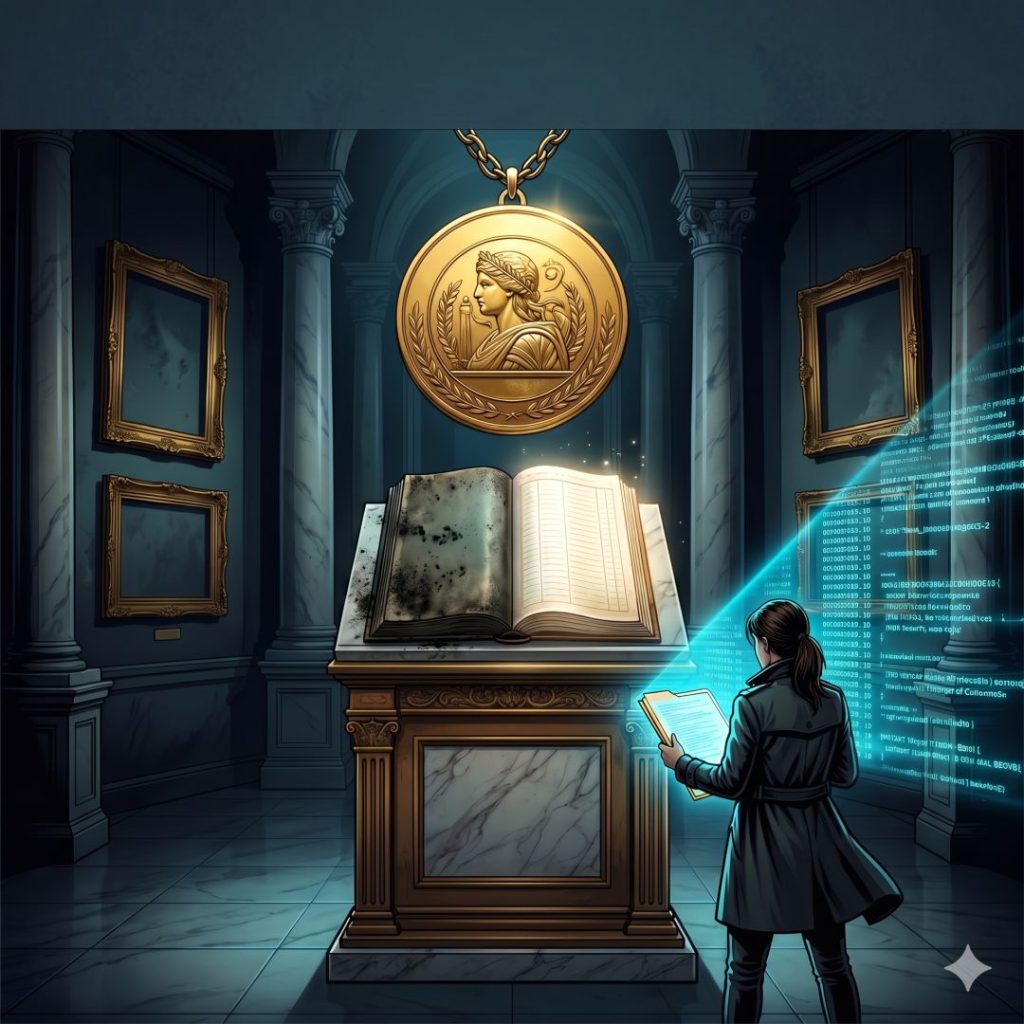
The Smithsonian awarded Anthony Amore a history medal for writing a book with a criminal, while the Isabella Stewart Gardner Museum frames sit empty after 20 years of him on the job.
There is a profound, almost insulting irony in the choreography of institutional theater. On Tuesday, April 14—the exact birthday of Isabella Stewart Gardner herself—Anthony Amore stood before a crowd to sell a carefully curated illusion. Visit crimeandcanvaspodcast.com and click on the evidence link in the top navigation to view the evidence.
While the Gardner Museum’s legacy remains anchored to a 36-year cover-up, its Director of Security and Chief Investigator was busy at the Quincy Main Library promoting his latest release, The Rembrandt Heist. He wasn’t there to answer for the empty frames hanging in his own museum. Instead, he was spinning the tale of Myles Connor and a 1975 theft at the Boston Museum of Fine Arts. While Amore sells a curated fiction, you can read my forensic audit of the true Rembrandt Heists—and the Imperial Shopping List of the Dutch billionaire operating as a cultural heritage criminal. You can view that by visiting the crimeandcanvaspodcast.com website and clicking on the evidence link in the top navigation.
The most damning piece of this promotional tour isn’t the book itself—it is the institutional stamp of approval it carries. Amore’s work is proudly touted on his marketing materials as being named one of the “Top Ten History Books of 2025 by Smithsonian Magazine”.
HISTORY?
His book is pure fiction. I am genuinely confused. My work is currently listed as fiction simply because I am still systematically proving my ledger—while his work is labeled “History” despite lacking the forensic foundation that would actually substantiate his claims. How is it that his account is validated as historical record while mine is sidelined, when my forensic audit proves the evidence his narrative ignores?
I want all of you to understand that I didn’t even know about Anthony Amore’s antics until the end of December 2025. I am just as shocked at the outcome of my mother’s little flea market story as I am sure most of you are. I didn’t go looking for this system; the evidence simply dragged me to it.
The Smithsonian award is exactly how a compromised ledger is laundered in plain sight. I think I have just been the one lucky enough to hang in there to see the clarity that only someone on the true outside could truly see.
The Smithsonian is using its legacy to validate Anthony Amore as an authoritative historian. And don’t get me started on the Smithsonian’s David Koch Hall of Human Origins exhibit inspired by the stolen—and now returned—Charles Darwin notebooks of Cambridge University in England.
The Smithsonian isn’t just misguided; they are standing with Anthony and his con. They have the David Koch exhibit and the millions in donor influence to protect. By awarding a gatekeeper who has spent 20 years failing to recover a single piece of the Gardner art, the Smithsonian is actively wrapping a fabricated history in an aura of academic excellence. It is the ultimate shortcut for the chaperoned runner: you don’t solve the crime you were hired to protect; you simply have your elite network award you a medal for writing about someone else’s. And the Rembrandt heist they write about in the book wasn’t some great solve; it was Myle’s get-out-of-jail-free card.
Plus, in addition to my Imperial Shopping List, I am laying out my theory on the 1969 Palermo heist—the theft of Caravaggio’s Nativity with St. Francis and St. Lawrence. If a criminal network can pull off the FBI’s #1 art crime, they can certainly pull off #3. The authorities blamed the mafia (hmm is that already a pattern?) and fed the public a ridiculous story about the canvas being used as a rug. The reality? The mafia’s Italian mothers would have killed them for stepping on a Catholic altarpiece.
Could you imagine their faces when they would in walk in and … that doesn’t even make any sense… don’t even imagine it cause it doesn’t make sense…
A nine-foot painting like that requires a massive wall, and it was always destined for a private mansion, not a mafia hideout.
The public face of the establishment remains completely dark, but the community is waking up to the data, and the gatekeepers are studying it in total, paralyzed silence. The circle is widening, the “Nobody” narrative is dead, and the community is now actively auditing the elite. Now, let’s look at the digital receipts that prove it.
Institutions rely on a very specific weapon to manage a crisis: Silence……………….. (like that) – The “Wall of Silence” is an illusion. They build a public wall of non-response, hoping that if they ignore a whistleblower long enough, they will give up. But I continue to stand by my hashtag #NeverGiveUp
For years, we have been fed a curated narrative by Anthony Amore. We have been told what to look at, what to believe, and how to view the empty frames. But while the public is fed the con, my server logs tell a completely different story.
They want the world to believe that outside investigations are just shouting into the wind. But behind the scenes, the digital receipts reveal total administrative paralysis.
This isn’t a broadcast to a random audience; it is a direct, curated delivery to a hand-selected ledger. I manage the list, determining exactly who receives the data and monitoring exactly when they engage it. And while the public face of these entities remain completely dark, my backend server logs are capturing the undeniable truth.
They aren’t ignoring the forensic ledger. They are consuming it. (with their bowl of popcorn)
Who is Watching the Ledger? The Federal Bureau Track: Zero Ignorance
The oldest corporate defense is to claim a file was never received, lost in the spam folder, or routed to the wrong desk. The data I present completely strips that defense away.
The premier law enforcement agency in the country isn’t filtering these updates into a junk folder. Their eyes are fixed directly on the coordinates.
If we look at the Isabella Stewart Gardner Museum analytics, we can see the exact moment the panic set in—the moment Anthony Amore realized I had solved it, and I was getting closer to finding he was my gatekeeper.
If you want to see what systemic exposure looks like, look at the internal network logs of the Isabella Stewart Gardner Museum. For the email address theft@isgm.org, on December 3, 2025—immediately following the email I sent to Harvard University of the Notice of Breach of Fiduciary Duty—the server activity captured an unprecedented spike in his traffic.
His panic was on the email titled – Hello, Harvard! I Believe I Have a Gift for You—The ISGM!
I unsubscribed his email accounts on January 15, 2026. If you look at the logs, you can see they continued to return to the data up until April 18, 2026. That is four days after Anthony Amore was at the Quincy Main Library promoting his book.
Furthermore, he opened the newsletter titled “Demand for Investigation and Accountability: Isabella Stewart Gardner Museum Art Heist.” This issue was sent on May 9, 2025, nineteen days before the Change.org event (of the Heywood Jablowmey on May 28, 2025). Someone is reading this specific newsletter almost a year later. They are aware of my statements.
To Everyone in the Room-I am not here to expose bystanders or violate privacy; I am here to hold the gatekeepers accountable. As a whistleblower, it is my duty to share the elements of this story that force the truth into the light. They are waiting for me to get tired. They are waiting for the “Nobody” to stop sending the emails. They are relying on no one ever stepping forward to stand beside me.
If you think I’m guessing, look at the logs. They don’t lie. They are in the room, they are reading the audit, and they know exactly what I am watching. To view these evidentiary analytical logs, visit the crimeandcanvaspodcast.com website and click on the evidence link in the top navigation.
Let’s be very clear: I am NOT an armchair detective. I am a whistleblower with first-hand art encounters from 1991 and 1992 involving my mother. Art encounters 45 minutes from Palm Beach. A whistleblower’s story isn’t public knowledge—that is why they are called a whistleblower. I am proud to stand up for the truth that everyone else is too afraid to touch.
Standing with Mary. Standing with Isabella. Standing for Boston. Where do you stand?
Visit CrimeandCanvasPodcast.com to read the timeline for yourself and sign the Change.org petition.
And remember, if you’re going through a similar struggle, if you have a voice that needs to be heard, visit TheNobodyMandate.com to learn how you can get help.
Thank you for joining me on the Crime and Canvas Podcast. This is Suzanne Kenney. I’m grateful for your time and your willingness to hear this story. Let’s always remember: The truth is still the truth, even if no one believes it. Or even if they try to ignore it.