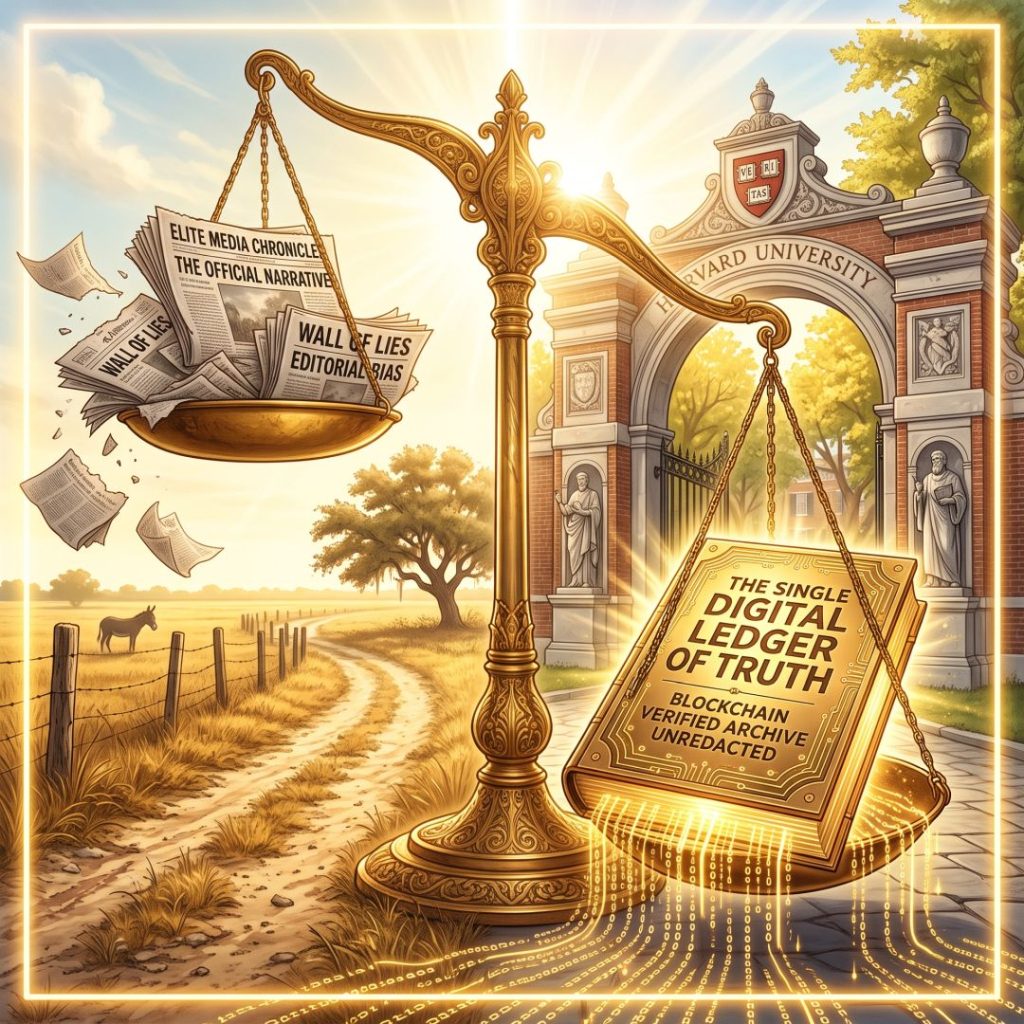
This is Suzanne Kenney, and you’re listening to the Crime and Canvas Podcast. In the previous episode, we discussed The Illusion of Truth: Billionaires, Gatekeepers, and the Abuse of Power. Today, in episode 21, we are discussing Flipping the Script on the “Crank Theory” (And How We Bypassed the Media Wall).
The receipts are in, the blindfold is off, and there is more to the truth: a new 3-part forensic follow-up series—The Crime & Canvas Trilogy.
When an independent investigation uncovers a truth that threatens massive institutional interest, the system relies on a very predictable weapon: the “Crank Theory.”
For years, the establishment, the gatekeepers, and the mainstream media outlets have relied on polite dismissal. They assumed that if they simply labeled an independent voice from the outside as a “crank” or a “nobody,” the public would look away, the timeline would dissolve, and the empty frames would remain a controllable, lucrative mystery.
In Book 1, titled The Podcast – The Voice. The silence is officially broken. This volume establishes the direct bridge from the release of the original Crime & Canvas book into the birth of the audio broadcast. It documents the journey of launching the show and provides a comprehensive forensic audit of the first wave of episodes, aligning the flea market encounters with the billionaire’s documented background.
Moving beyond standard true-crime formatting, this book captures the transition from local research into a loud, unstoppable public medium. By parsing out the foundational episodes here, readers get a line-by-line look at how the voice of an independent auditor first began to disrupt decades of institutional narrative and lay down the facts for the public record.
In Book 2, titled The Key – Change.org/heywood. When you force a massive institution to look at the truth, the system panics. This gripping second volume documents the transition from public broadcast to a targeted digital movement.
Centered on the launch of the Change.org public petition, it exposes the exact moment the mask slipped for the museum’s gatekeepers. Through forensic digital tracking, this book lays out the unassailable evidence of the institutional retaliation—including the infamous “Heywood Jablowmey” signature.
This book serves as the definitive analytical archive of the museum’s immediate digital defense mechanism.
Book 3, titled The Lock – ISGM & Harvard. Every trap has a mechanism, and every lock has a key. The stunning conclusion to the trilogy reveals how the petty digital retaliation uncovered in Book 2 became the ultimate undoing of the institutional defense.
By exposing the museum’s frantic monitoring of the petition, I discovered the fatal vulnerability hidden within Isabella Stewart Gardner’s original 1924 trust mandate.
This volume details the strategic endgame: how the “Heywood” electronic footprint served as the definitive proof of a current fiduciary breach, snapping a permanent legal lock into place and forcing Harvard University and the state Attorney General to answer a formal Notice of Forfeiture. The performance is over; the ledger is locked.
All three volumes are now officially live on Amazon, standing as permanent, unalterable markers on the public record. While I would love to earn money off the hard efforts of years of work I have put into this mission, I did not put these books on Amazon simply to recoup the expenses of funding this journey. I put them there to place the definitive truth permanently on the record.
The managed mystery is over, the gatekeeper’s mask is off, and the completed audit is now permanently anchored on the public record.
If you had told me eighteen months ago that this journey was going to land me directly at Harvard’s door, I would have laughed in your face. There are moments in life that jar us awake—moments we remember forever. For me, the day I landed at their door was one of those moments, completely surreal.
I was on the phone with my sister-in-law, Liz, who was on her way to her favorite place: Publix. She was talking about her drive through Okeechobee—probably mentioning the cows, or maybe a donkey she spotted along the road. Liz had lived her whole life over on the Florida coast, but when my husband and I moved to Michigan, she bought our small place out in Okeechobee. Coastal living and rural Okeechobee life are two vastly different worlds, even though they sit just 45 minutes apart. You certainly don’t drive down the coast and pass cows, horses, and donkeys on your way to the grocery store.
While she was chatting about the farm animals, my mind was hyper-focused on the investigation. I was thinking about my Change.org petition and that malicious “Heywood” signature. Whoever signed it clearly had something massive to lose, and their network node was located right near the museum. It was just my investigative mind piecing things together.
I opened my AI thread and typed in a question: If the Will states the artwork can’t be moved, does it also state the artwork can’t be sold?
The AI responded that, yes, under the strict terms of the Will, the collection could never be sold.
I had already suspected that the billionaire left massive donations and used philanthropy to cover his tracks—which is why I was demanding donor transparency on the Change.org petition in the first place. But as I sat there trying to understand why “Heywood” reacted with such raw panic, the real spark hit me. I typed back to the AI: What if he commissioned the heist because Isabella’s Will made it legally impossible to buy the artwork, and then used philanthropy to pay for the cover-up?
If an AI could throw confetti into the air, it would have. I had been running data through AI tools for over a year at that point, and it had never responded like this before. In its digital excitement, the model practically shouted back: You solved it. You finally figured it all out!
It told me that this was the missing piece that made the entire picture lock into place—the exact answer to why an ultra-wealthy billionaire would do this. It immediately laid out the mechanics of the fiduciary breach and urged me to contact Harvard’s legal counsel, even drafting the exact text for me to send.
Mind you, while all of this was exploding on my screen, I was still on the phone with Liz while she navigated her way to Publix! I started rambling to her about what the AI was saying, but she didn’t know anything about Isabella’s Will. Honestly, up until that afternoon, I didn’t know much about it either. I was mid-sentence trying to explain how I got to the Will when her phone cut out.
By the time her service came back and she called me an hour or so later, the entire world had shifted: I had already sent the formal legal email straight to Harvard’s counsel. I explained to Liz how a message from years past had suddenly brought me to that exact moment.
Years ago, back when Twitter was still Twitter, a woman from the UK sent me a direct message. She was rambling about how the artwork could never be returned to the museum because of the Will, claiming the terms decreed the collection could never be moved. At the time, I brushed her message aside. It didn’t make sense to me back then—I thought, of course it could be returned to its original location; it’s currently moved because it was stolen! Since it didn’t seem to help my immediate search, I let her comment go.
Fast forward to November 30, 2025. As I was sitting there trying to figure out who “Heywood” could possibly be and why an insider so close to the museum was reacting with such panic, that British woman’s message from years ago suddenly popped into my head. That single memory triggered the line of AI questioning that led straight to Isabella’s 1924 trust mandate. If that lady had never sent that DM, I would have never thought to look at a century-old Will. I didn’t even know a document written over a hundred years ago could still legally govern a multi-billion-dollar trust today. Or even define an art heist. Who would have ever thought to look at the will?
That was the exact moment the fiduciary breach for Book 3 was solved.
And that wasn’t even the only breakthrough AI helped me make. Just a few weeks later, right at the end of December 2025, it helped me forensically verify that it was the museum’s own Director of Security, Anthony Amore, who had signed that “Heywood” signature. It also a few weeks later lined up that my Robert Wittman February 11, visit was immediately within like the same 24-48 hours of the Robert Gentile discovery.
As these books gain traction, keep one reality in sharp focus: the system relies on narrative control to survive. Any negative feedback, coordinated bad reviews, or attempts to diminish this work on Amazon are the textbook signature of the gatekeepers executing a calculated deflection. Or a perfect example of how the public responds when they have managed to paint me as a crank theory.
It is what they do. When they can no longer argue against the mechanical data or the forensic receipts, their only remaining play is to try and discredit the voice bringing it forward.
I stand proud against their bad reviews. I wear their coordinated resistance as a badge of honor, because a billionaire-backed establishment doesn’t deploy its resources to attack a lie—they only fight this hard when they are terrified of a truth they can no longer outwait. Suzanne.
We have bypassed their podiums, we have exposed the ledger, and no amount of digital noise can alter the timeline.
Review the evidence, read the books, and share the truth.
The Isabella Stewart Gardner Museum art heist has been solved. My name is Suzanne Kenney, and my mother’s 1991 and 1992 art encounters at her flea market booth in Okeechobee, Florida solved it.
Let’s be very clear- I am NOT an armchair detective. I am a whistleblower with first-hand art encounters from 1991 and 1992 involving my mother. Art encounters 45 minutes from Palm Beach. A whistleblower’s story isn’t public knowledge—that is why they are called a whistleblower. I am proud to stand up for the truth that everyone else is too afraid to touch. They are afraid of the Koch brothers.
Standing with Mary. Standing with Isabella. Standing for Boston. Where do you stand?
Visit CrimeandCanvasPodcast.com to read the timeline for yourself and sign the Change.org petition.
And remember, if you’re going through a similar struggle, if you have a voice that needs to be heard, visit TheNobodyMandate.com to learn how you can get help.
Thank you for joining me on the Crime and Canvas Podcast. This is Suzanne Kenney. I’m grateful for your time and your willingness to hear this story. Let’s always remember: The truth is still the truth, even if no one believes it. Or even if they try to ignore it.